
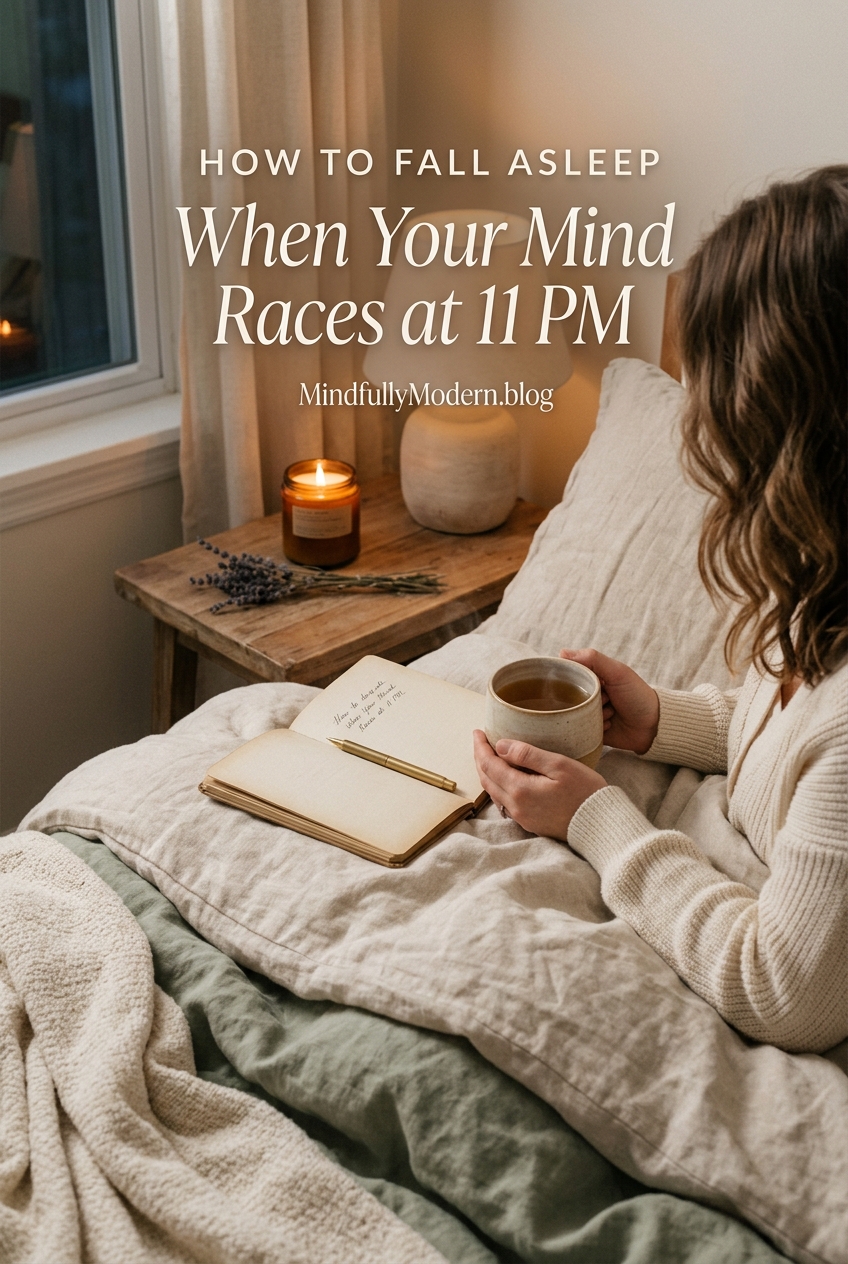
The clock reads 11:17 PM. Your body is heavy with exhaustion, but your mind? It’s cataloging every unfinished email, replaying that awkward conversation, rehearsing tomorrow’s to-do list. You know you need sleep. You want sleep. But figuring out how to fall asleep when a racing mind takes over feels impossible in these late-night moments.
If you’re a sensitive woman who often finds herself staring at the ceiling while thoughts loop endlessly, you’re not broken. Your nervous system is simply stuck in a hypervigilant state—and it needs gentle redirection, not force. These nine soft tools offer that redirection.
Why Your Mind Races Right When You Need Sleep Most
Your brain isn’t sabotaging you on purpose. When you finally stop moving and lie down, your nervous system interprets the stillness as an opportunity to process everything you suppressed during the day. For highly sensitive women, this processing can feel overwhelming.
Racing thoughts at bedtime often signal that your body hasn’t fully transitioned out of its alert state. Your sympathetic nervous system—the part responsible for action and vigilance—is still partially activated. Understanding this connection through our Nervous System Regulation guide can help you approach sleeplessness with more compassion and fewer tactics that accidentally amp you up further.
The goal isn’t to force your mind quiet. It’s to create conditions where your body feels safe enough to naturally downshift.
The 4-7-8 Breath (But Softer Than You’ve Heard It)
You’ve probably encountered breathwork before, but most instructions feel too rigid for a racing mind. Try this gentler approach: breathe in quietly through your nose for a count of four, hold for seven, exhale through slightly parted lips for eight. But here’s the key—let the counts be approximate. If you lose track, simply start again without judgment.
The extended exhale activates your vagus nerve, signaling safety to your nervous system. Do this three to four times, letting your jaw stay loose and your shoulders drop with each round.
The Sensory Scan That Actually Works
Traditional body scans can backfire when your mind is racing—they require too much focus. Instead, try this: notice five things you can physically feel right now without moving. The weight of the blanket on your shin. The coolness of the pillowcase against your cheek. The softness of your palm resting on your ribs.
This isn’t meditation. It’s gentle redirection. You’re giving your spinning thoughts something tangible to land on, something that exists only in this present moment. When your mind wanders back to tomorrow’s presentation, simply return to sensation. The texture of your sheets. The temperature of the air on your face.
How to Use Essential Oils for Sleep Without Overthinking It
Aromatherapy works for racing minds because scent bypasses your cognitive brain entirely, speaking directly to your limbic system. You don’t need an elaborate ritual—just one or two drops of lavender or cedarwood on your pillowcase, or a rollerball blend applied to your wrists.
The key is choosing a scent that feels personally soothing, not one you think you should like. Some sensitive women find lavender too sharp. Others prefer the woody warmth of sandalwood or the green calm of clary sage. Trust your nose.
Write It Down (Just Three Lines)
Keep a small notebook beside your bed—not for journaling, but for thought-dumping. When your mind loops on a specific worry or task, write down just enough to capture it. Three lines maximum. This isn’t problem-solving time; it’s an agreement with yourself that you’ll handle it tomorrow.
The physical act of transferring a thought from your head to paper signals to your brain that the information is stored safely. You can stop rehearsing it now.
a quieter inbox
Like this slower kind of writing?
Subscribe for soft letters — slow living, hygge, nervous-system care, & the four free gifts.
Gentle Rituals for When You’re Already in Bed
Sometimes you’re already horizontal when the racing starts. You don’t want to get up and “start over” with a whole bedtime routine. These micro-adjustments can help without requiring you to leave your nest:
- Place one hand on your heart, one on your belly, and breathe into the warmth of your own touch
- Tense your toes tightly for five seconds, then release completely—repeat with calves, thighs, working upward
- Visualize a color (any color that feels soft to you) slowly filling your body from your feet upward
- Hum quietly on your exhales—the vibration naturally calms your vagus nerve
- Count backward from 100 by threes, letting yourself lose track and start over without frustration
Pick just one. The goal is simple nervous system soothing, not perfection.
What to Do When Nothing Seems to Be Working
Some nights, despite your gentlest efforts, sleep stays elusive past midnight. This is when the kindest thing you can do is release the pressure. Get up. Move to another dim space. Read something undemanding or listen to a podcast with a soothing voice.
The worst thing you can do for a racing mind is lie there battling it, watching the clock, calculating how many hours of sleep you’re losing. That activates even more stress response. Sometimes how to fall asleep when a racing mind won’t quiet is to temporarily stop trying—paradoxically, this often allows sleep to find you.
If you find yourself awake past 1 AM more than twice a week, or if racing thoughts are accompanied by heart palpitations or persistent dread, consider talking with a healthcare provider. Chronic sleep disruption deserves support.
The One Thing Most Sleep Advice Gets Wrong
Most advice treats racing thoughts like a problem to fix with discipline—better sleep hygiene, stricter routines, more rigorous wind-down protocols. But for sensitive women, this approach often backfires. It adds another layer of pressure, another thing you’re not doing perfectly.
The truth? Your racing mind is often a symptom, not the root issue. It’s your body’s way of saying it doesn’t feel safe enough yet to fully let go. Address that underlying sense of safety—through nervous system care, through releasing the day’s tension, through self-compassion—and sleep becomes accessible again.
You don’t need to earn rest through perfect execution of bedtime rituals. You need permission to soften, to lay down the hypervigilance, to trust that you can handle tomorrow when tomorrow comes.
Building Your Own Late-Night Toolkit
Not every tool will resonate with you, and that’s exactly right. Bookmark two or three approaches from this list that feel doable in your sleepiest, most vulnerable state. Maybe it’s the breath pattern and a drop of lavender. Maybe it’s the three-line thought dump and a sensory scan.
Write them on a note card and keep it visible on your nightstand. When 11 PM arrives and your thoughts start spinning, you won’t have to remember what helps—you’ll have your own soft toolkit ready.
The goal isn’t to never experience racing thoughts again. It’s to have gentle, reliable ways to guide yourself back to calm when they arrive. Some nights will be easier than others. Some nights you’ll fall asleep in minutes; others, you’ll practice every tool twice. Both are okay. You’re learning to work with your sensitive nervous system, not against it—and that’s the quietest revolution of all.
Get my free 7-day slow living email series
One short email each morning. Gentle rituals for softer days. No spam, unsubscribe anytime.
Leave a Reply