
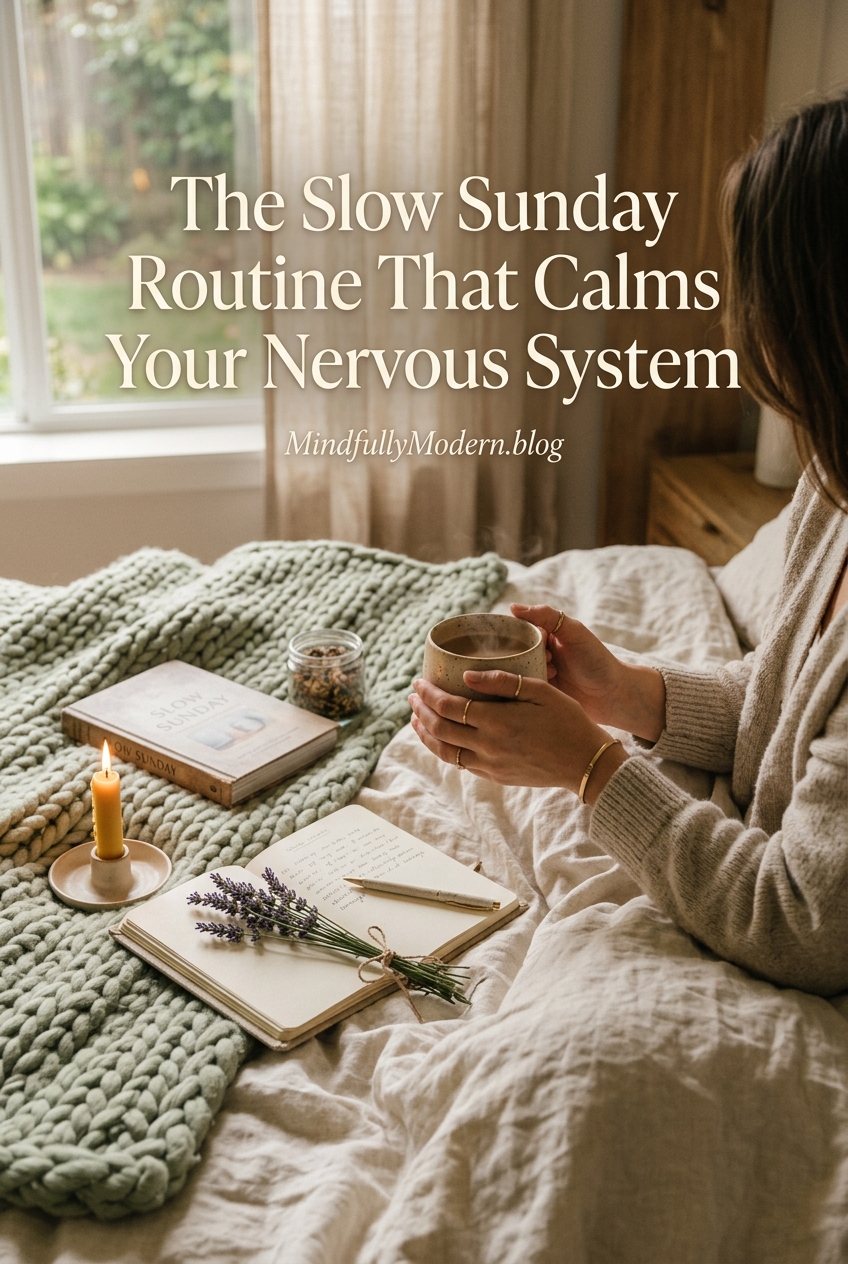
The light filters differently on Sunday mornings. Softer, somehow. Less urgent. And if you’ve spent the week moving faster than your body wanted to, answering more questions than your mind had space for, your nervous system knows the difference between this quieter day and all the others.
A slow Sunday routine isn’t about productivity disguised as rest. It’s about creating intentional space for your overstimulated system to finally exhale—to move from survival mode back into something that feels like *you* again.
Why Your Nervous System Needs Sunday Differently
By the time Sunday arrives, most of us are carrying an invisible backlog. Your nervous system has been fielding demands all week—notifications, decisions, conversations, transitions, stimuli your sensitive body absorbs whether you realize it or not.
Sunday offers something rare: permission to move at a pace your body actually recognizes as safe. When you build a routine around slowness rather than accomplishment, you’re sending your nervous system a clear message: *we’re not running anymore. You can rest now.*
This matters especially for highly sensitive women, whose systems register stimulation more deeply and need longer recovery windows. A slow Sunday isn’t indulgent—it’s physiologically necessary.
What Makes a Sunday Routine Actually Restorative
The difference between a restorative Sunday and one that still feels somehow *busy* comes down to pacing and presence. You’re not trying to fit in all the self-care tasks you skipped during the week. You’re creating a rhythm that feels like the opposite of rushing.
True restoration happens when you remove the pressure to optimize, produce, or even relax in any particular way. It happens in the spaces between—when you’re standing at the window with your tea, when you’re moving slowly enough to notice the texture of your sweater, when there’s nowhere else you need to be.
If you’re new to building gentler rhythms into your life, our Slow Living guide offers a foundation for creating this kind of spaciousness beyond just Sundays.
Morning: The Art of Not Hurrying
Begin your slow Sunday routine by refusing the rush. No alarms if possible. No immediate phone-checking. Let your body wake in its own time, then stay in bed a few extra minutes—not scrolling, just *being*.
When you do rise, move through your morning without efficiency as the goal. Make your coffee or tea with attention. Feel the warmth of the mug. Notice the steam. Sit somewhere comfortable and drink it while it’s still hot, which might be the most radical act of the entire day.
This isn’t about adding steps—it’s about removing the hidden hurry from the ones you’re already taking.
Sensory Rituals That Signal Safety
Your nervous system speaks the language of the senses. When you engage your body through gentle, predictable sensory experiences, you’re essentially telling your system: *we’re safe. We have time. Nothing is chasing us.*
Try weaving these into your slow Sunday routine:
a quieter inbox
Like this slower kind of writing?
Subscribe for soft letters — slow living, hygge, nervous-system care, & the four free gifts.
- Scent anchoring: Light the same candle or diffuse the same essential oil blend every Sunday morning—lavender and cedarwood, bergamot and frankincense, whatever feels like exhaling to you
- Texture attention: Wrap yourself in your softest blanket, run your hands over smooth surfaces, notice the weight of your favorite sweater
- Sound simplicity: Choose gentle background music, nature sounds, or deliberate silence instead of podcasts or news
- Taste slowness: Eat something you can savor—warm bread with butter, fruit you actually taste, soup you made yesterday that’s even better today
- Movement ease: Stretch on the floor, take a slow walk without a destination, do restorative yoga poses that require nothing from you
The repetition matters as much as the ritual itself. When your body recognizes these sensory cues week after week, Sunday becomes a neurological signal that it’s time to downshift.
How to Structure Hours Without Scheduling Them
The paradox of a slow Sunday routine is that it needs just enough structure to feel contained, but not so much that it becomes another obligation. Think in rhythms rather than clock times.
Perhaps your Sunday moves like this: slow morning, gentle movement, nourishment, a creative or contemplative practice, rest, simple dinner, early evening wind-down. No specific hours attached—just a loose container that keeps you from drifting into Sunday scaries or filling the space with tasks.
Leave gaps. Big ones. Unplanned stretches where you might read three pages or thirty, where you might take a bath or just sit, where nothing is decided in advance. These gaps are where your nervous system does its deepest repair work.
The Practice of Doing One Thing at a Time
If you’re used to multitasking as survival strategy, Sundays are for practicing the opposite. One thing. Fully. Then the next thing.
When you’re making lunch, just make lunch. When you’re reading, just read—not with your phone nearby, not half-planning tomorrow. When you’re resting, don’t also be mentally working through your week ahead.
This singular focus isn’t about productivity. It’s about giving your divided attention a day off, letting your nervous system experience what it feels like when you’re not constantly splitting yourself across multiple inputs. For highly sensitive people who absorb stimulation more deeply, this practice of reducing sensory and mental overload becomes essential weekly medicine.
Evening: The Transition Back
As Sunday evening arrives, the trick is not letting the weight of Monday collapse the spaciousness you’ve built. Your slow Sunday routine needs a gentle closing ritual—something that honors the transition without anxiety.
Maybe you prepare your space for the week ahead, but slowly. Maybe you journal three things you noticed today. Maybe you take a bath with magnesium salts and lavender oil, letting your body absorb the message that you’re still safe, still cared for, even as the week approaches.
Dim the lights earlier than usual. Put your phone in another room. Let Sunday end the way it began—softly, without hurry, with your nervous system knowing it was held.
You don’t need to get Sundays perfect. You just need to let them be slower than the rest of your week, gentler than your nervous system has learned to expect. That small consistent difference—that’s where the healing happens, one quiet Sunday at a time.
Get my free 7-day slow living email series
One short email each morning. Gentle rituals for softer days. No spam, unsubscribe anytime.
Leave a Reply